
Battery Basics
Your EMOVE Cruiser uses a 52V 30Ah LG lithium-ion battery with a Battery Management System (BMS) for protection.
Battery Size:
-
Length: 19"
-
Width: 4.5"
-
Height: 2.5"
Main Components of a Battery Pack:
-
Battery cells
-
Connectors
-
BMS (Battery Management System)
-
Wiring
Batteries are arranged in series (S) and parallel (P) to set voltage, capacity (Ah), and discharge rate.
-1.png?width=436&height=338&name=1280X1280%20(9)-1.png)
Charging Your Cruiser
-
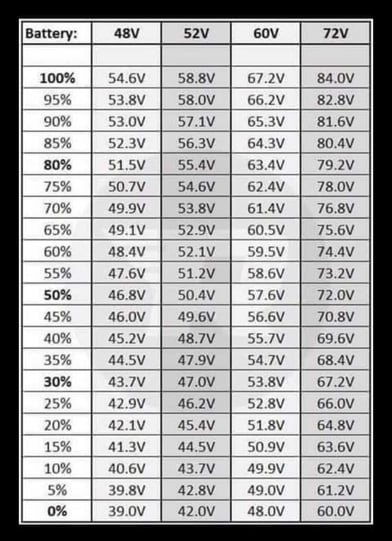
Full charge: 58.1 – 58.8V
-
Low battery: 41 – 43V
Tips for Charging:
-
Charge when the battery reaches 43V. Avoid fully exhausting the battery frequently—it reduces lifespan.
-
Avoid overcharging. Leaving it plugged in for a short while after full charge is okay, but extended overcharging can damage the battery.
-
Avoid rapid discharge whenever possible.
Checking Charge:
-
The charger light turns green when fully charged.
-
You can check voltage with a voltmeter, but don’t leave it on while charging.
-
Note: The voltmeter may show slightly different readings than the LCD—that’s normal.
Battery Management System (BMS)
-
Think of the BMS as the battery’s “brain.”
-
It protects cells from damage and prevents overcharging.
-
Even though the BMS protects the battery, unplugging after full charge is still recommended to extend battery life.
More about BMS: Battery Management System Info
Battery Life & Care
-
Charge cycles: ~700–1000 cycles
-
Ideal temperature: ~66°F (19°C)
-
Storage tips:
-
Keep battery at 30–80% charge when not in use.
-
If unused for a week or more, store at 50% charge.
-
Protect from vibration, moisture, and extreme temperatures.
-
Avoid punctures or physical damage—replace if damaged.
-
Do not leave charging overnight regularly.
-
Good practices:
-
Lithium-ion batteries are faster-charging, lighter, and longer-lasting than traditional batteries.
-
With proper care, a battery can last 2–3 years for the average rider.
-
If the voltmeter shows no reading or is below the battery’s voltage minus 12V, it’s likely a bad battery.
Video on battery care: Battery Care Tips
Voltage & LCD Info
-
Charger Max Voltage: 58.8V
-
Battery Voltage: 52V
-
Minor differences between voltmeter and LCD readings are normal.