
Tire sizes can be written in several different formats, depending on the type of vehicle or tire. Here’s a breakdown of the most common sizing methods and what each number means.
How to read those things From https://allterraintyres.co.uk/index.php?main_page=page&id=8
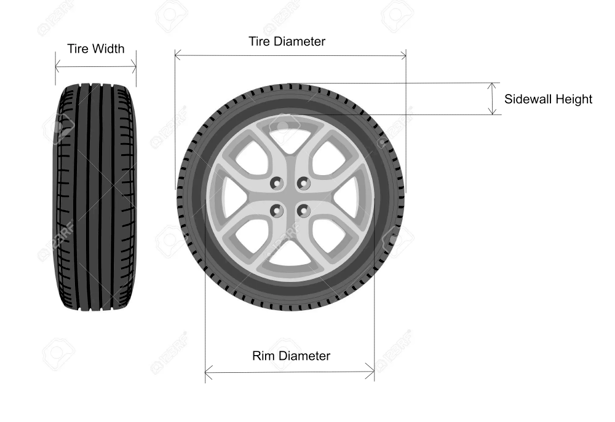
| Column 1 | Column 2 | Column 3 |
| Sizing Method | Example | Meaning |
| (Tire Width)-(Rim Diameter) | 3.00-4 | The first number is the width of the tire, the second is the rim it fits around (both in inches) So that example would be a tire with a width of 3 inches that would with a 4 inch rim. To convert from car rim size to bicycle and e-scooter rim sizing, add 4 to the second number, so the bike rim size would be 3.00-8 |
| (Tire Width)-(Rim Diameter) | 12-Jun | Same as above but they just do away with the decimal points. So this tire would be 6 inches wide and fit a 12 inch rim |
| (Tire Width)/(Sidewall Height)-(Rim Diameter) | 4.10/3.50-4 | First gives width of the tire, second number gives the sidewall height of the tire, the third number is the rim diameter. So this tire would have a width of 4.10 inches, a sidewall height of 3.50 inches and would fit a 4 inch rim |
| (Tire Diameter)x(Tire Width)-(Rim Diameter) | 11x4.00-4 | First gives the max diameter of the tire, second gives the width of the tire, and the third number gives the rim that the tire fits on. So this tire would be 11 inches in diameter, 4 inches wide, and fit a 4 inch rim. |
| (Tire Diameter)x(Tire Width) | 10x3 | First gives the max diameter of the tire, second gives the width of the tire. So this tire would have a diameter of 10 inches and a width of 3 inches. Note these can also be in millimeters, but you can tell if they are millimeters based on the size of the numbers. The example shown would not be millimeters unless the tires were for legos. |
| (Tire Width in mm)/(Sidewall Height as a Percentage of Width)-(Rim Diameter in inches) | 255/60-10 145R10 195/50R13 |
This is mostly used for cars, so its not as useful for us, but it may come up. This one uses millimeters and inches and percentages, the first is the width in mm, the second is the sidewall height as a percentage of that width. The third number is the rim it fits in inches. If no percentage value is given, we assume the percentage to be 80% If an R is present, that means that the tire is of "radial construction" In the first example, this would be a tire with a 255mm width, a sidewall that is 60% of that (153mm) and it would fit a 10 inch rim. If you want the tire diameter, you would convert the sidewall height to inches, double that value and add it to the rim diameter., so this example would have a tire diameter of 22 inches (10 inch diameter + 2x6 inch sidewalls) The second example would have a width of 145mm, the sidewall percentage would be 80%, the tire would be radially constructed and it would fit a 10 inch rim. The third example is 195mm wide, the sidewall is 50% that of the width, it is radially constructed, and it fits a 13 inch rim. |
✅ With these guidelines, you can quickly decode tire markings and determine their width, diameter, and compatibility with your rim.